These are the key words fashioning design in banking.
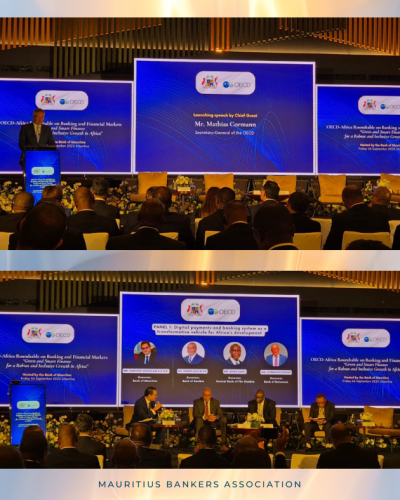
Central Bank Governors from Africa gather in Mauritius to discuss digital payments at a conference on Green & Smart Finance.
While the Central Bank of Nigeria boosts sustainable banking practices, in a move to integrate the Trillion dollar club, by 2031.
Find out more in this latest issue.
Best wishes, The MBA team
Green and Smart Finance: OECD-Africa Roundtable
6 September 2024
Central Bank Governors from Mauritius, Zambia, Gambia & Botswana debated digital payments as a transformative vehicle for Africa’s development on 6 September 2024, as part of the OECD-Africa Roundtable on Banking and Financial Markets.
The event marked the official visit to Mauritius of the Secretary-General of the OECD, Mr. Mathias Cormann; who delivered opening remarks on “Green and Smart Finance for a robust and inclusive growth in Africa”.
It included signatures of a Memorandum of Understanding for the OECD Country Programme, and of the Letters of Exchange for Mauritius to adhere to the OECD Declaration on International Investment and Multinational Enterprises, and was hosted by the Bank of Mauritius at Le Méridien Hotel, Balaclava.
New GAFILAT guide: Why asset recovery laws need to align with human rights and other international standards
8 August 2024
‘As the guide explains through a study of the jurisprudence of the European Court of Human Rights, the issue is constantly evolving. The guide provides Latin American legislators and practitioners with examples of how to develop the human rights approach in a clearer way and enables them to critically review concrete non-conviction based forfeiture cases in various parts of the world. It emphasises two human rights that are central to non-conviction based forfeiture: the right to property and the right to a fair trial.’
How digital banking is driving the UAE's sustainability agenda
22 August 2024
‘Digital banking has emerged as a tangible way to drive green outcomes, and the benefits are enormous. Digital banking processes reduce paper usage through electronic transactions and e-statements, helping conserve the environment. They also require less infrastructure, thereby cutting energy consumption and carbon footprints. By reducing the number of physical branches, digital banking helps reduce carbon emissions. Energy used for lighting, heating, and cooling, as well as resources for maintenance and upkeep, are conserved. Customers don’t have to travel to a bank to make transactions, thereby reducing emissions from transportation.’
When integrating blockchain technology, banks must first ensure that they quantify the actual transactions that need to be backed by blockchain vs. blindly expecting every atom of data to be stored there. They can then review public/private blockchain and strength of consensus. Many transactions are of low value and can avoid blockchain altogether using AI and risk-based transaction analytic models. Other transactions may be high value or there may be special applications where every transaction would be on blockchain because these transactions are of significant importance and the immutability to their existence critical.’
CBN drives sustainable banking, IFRS adoption to attract foreign investment
20 August 2024
‘In addition to financial reporting, the CBN is driving sustainability within the banking sector. In collaboration with the Bankers’ Committee, the CBN introduced sustainable banking practices in 2020. These principles focus on managing environmental and social risks, promoting economic stability, and ensuring access to finance for underserved segments of the economy. The principles also emphasize the importance of transparency, with banks required to disclose their sustainability efforts in their audited financial statements. The impact of these sustainability initiatives is evident in the growing number of bank branches and ATMs powered by renewable energy, as well as improved waste management practices across the sector.’
Put in place frameworks to manage failure of deposit taking institutions: Patra to deposit insurers
13 August 2024
‘Deposit insurers are having to re-evaluate operational risks posed to depositors and member banks from the emergence of these 24/7 payment systems, he said. While digital innovations can ease the cross-border supply of financial services, they can also increase the likelihood of deposit insurers being exposed to member banks with a significant share of non-domestic depositors and additional challenges in the case of a payout following bank default. Patra further said deposit insurers must remain ready for tokenised deposits by reflecting on how to modify their mandates and coverage, considering that tokenised deposits are essentially claims on issuing banks like other forms of deposits.’
Bandhan Bank introduces new savings product 'avni' exclusively for women
22 August 2024
‘The product called “avni” is targeted at the affluent segment of the society. The customers opting for this product will have to maintain an average quarterly balance of Rs 25000. The bank will offer a debit card with free airport lounge access, personal insurance cover of Rs 10 lakh and discount in processing fee on gold loans, annual locker rentals to customers enrolling to the avni scheme, executive director Rajinder Babbar said.’
HKMA links data platform with Companies Registry to help SMEs open bank accounts
26 August 2024
‘Hong Kong’s de facto central bank is pulling out all the stops to help the city’s struggling small and medium-sized (SME) businesses open accounts remotely and access loans. Close on the heels of setting up the Task Force on SME Lending last Friday to help SMEs and mortgage borrowers get funding, the Hong Kong Monetary Authority (HKMA) on Monday expanded its electronic platform designed to help SMEs by linking up with the Companies Registry to share more data with banks. HSBC and Bank of China (Hong Kong), the city’s two biggest lenders and note-issuing banks, are among the first batch of banks to connect to the Companies Registry via the HKMA’s Commercial Data Interchange (CDI).’
South African Banks to Cut Digital Payments to CMA Countries – Standard Bank
13 August 2024
‘South African banks, in the next month, will halt electronic fund transfer (EFT) services to Namibia, eSwatini, and Lesotho, restricting clients from transferring money to these Common Monetary Area (CMA) countries. From September 4th, EFT services will be unavailable to South African customers wishing to send money electronically to these key Southern Africa Development Community nations. The South African Reserve Bank (SARB) has announced that from September 30, EFTs, debit, and credit card payments between CMA countries will be classified as cross-border transactions…. This move is part of South Africa’s broader efforts to implement recommendations from the FATF aimed at strengthening anti-money laundering measures, combating the financing of terrorism, and addressing proliferation financing. “Regularising these low-value retail payments will support our objective of exiting the FATF grey list by January 2025,” SARB added.’
This website uses cookies to improve your experience while you navigate through the website. Out of these, the cookies that are categorized as necessary are stored on your browser as they are essential for the working of basic functionalities of the website. We also use third-party cookies that help us analyze and understand how you use this website. These cookies will be stored in your browser only with your consent. You also have the option to opt-out of these cookies. But opting out of some of these cookies may affect your browsing experience.
Necessary cookies are absolutely essential for the website to function properly. These cookies ensure basic functionalities and security features of the website, anonymously.
Cookie
Duration
Description
cookielawinfo-checkbox-analytics
11 months
This cookie is set by GDPR Cookie Consent plugin. The cookie is used to store the user consent for the cookies in the category "Analytics".
cookielawinfo-checkbox-functional
11 months
The cookie is set by GDPR cookie consent to record the user consent for the cookies in the category "Functional".
cookielawinfo-checkbox-necessary
11 months
This cookie is set by GDPR Cookie Consent plugin. The cookies is used to store the user consent for the cookies in the category "Necessary".
cookielawinfo-checkbox-others
11 months
This cookie is set by GDPR Cookie Consent plugin. The cookie is used to store the user consent for the cookies in the category "Other.
cookielawinfo-checkbox-performance
11 months
This cookie is set by GDPR Cookie Consent plugin. The cookie is used to store the user consent for the cookies in the category "Performance".
viewed_cookie_policy
11 months
The cookie is set by the GDPR Cookie Consent plugin and is used to store whether or not user has consented to the use of cookies. It does not store any personal data.
Functional cookies help to perform certain functionalities like sharing the content of the website on social media platforms, collect feedbacks, and other third-party features.
Performance cookies are used to understand and analyze the key performance indexes of the website which helps in delivering a better user experience for the visitors.
Analytical cookies are used to understand how visitors interact with the website. These cookies help provide information on metrics the number of visitors, bounce rate, traffic source, etc.
Advertisement cookies are used to provide visitors with relevant ads and marketing campaigns. These cookies track visitors across websites and collect information to provide customized ads.